|
|

| Feb-16-2012 |
AGI |
MEG |
| Open |
10.80 |
1.71 |
| High |
11.80 |
1.71 |
| Low |
10.58 |
1.68 |
Close (2/15)
|
10.70 |
1.71 |
| Change |
-0.08 |
0.00 |
|
|
|
| Real Estate | Food and Beverages | Quick Service Restaurant | Tourism and Gaming |
Real Estate

Megaworld Corporation
Through the years, Megaworld has been developing integrated mega-communities that offer basically everything that tenants want and need. This the Company does in pursuit of its prime objective of providing the "perfect" community that offers comfort, convenience and everything else.
Megaworld believes that the perfect community is one that fulfills the basic needs of its residents and tenants—comfort, convenience, and security, among others. With this in mind, Megaworld set out to develop complete mega-communities where residents can live, work, play, learn, and even shop—all within their areas of residence. Megaworld, in fact, pioneered the "live-work-play-learn" development concept—building perfect communities that not only have residences but also workplaces, commercial establishments, and learning institutions.
Megaworld is one of the leading property developers in the Philippines and is primarily engaged in the development in Metro Manila of large scale mixed-use planned communities, or townships, that integrate residential, commercial, leisure and entertainment components.
Founded in 1989, Megaworld initially established a reputation for building high-quality residential condominiums and commercial properties located in convenient urban locations, with access to offices and to leisure and entertainment centers in Metro Manila. Beginning in 1996, in response to demand for the lifestyle convenience of having quality residences in close proximity to office and leisure facilities, Megaworld began to focus on the development of mixed-use communities, primarily for the middle-income market, by commencing the development of its Eastwood City project.
Megaworld's real estate portfolio includes residential condominium units, subdivision lots, as well as office projects and retail space. Megaworld's current land bank consists of real estate that it has acquired in prime locations in the Philippines such as Makati, Quezon City, Iloilo and Cebu. In 2007, Megaworld acquired a 54- hectare property which was the site of the old domestic airport in Mandurriao, Iloilo, on which its expects to develop a township community. It also acquired a 25-hectare property in Mactan, Cebu where it plans to develop a mixed-use project. In 2009, Megaworld continued to increase its land bank for development projects by acquiring development rights for the government-owned properties such as the JUSMAG and NAPOLCOM properties.
In 2009, Megaworld's 20th year of operations, the Company experienced another banner year as its residential projects continued to perform well and the growth of the BPO industry further created increasing demand for office spaces. As such, Megaworld's net income amounted to a record P4.06 billion in 2009, 7.1percent higher than the previous year's net income of P3.79 billion. Total revenues, in turn, grew by 2.7 percent to P17.76 billion from P17.30 billion in 2008. The increase in total revenues was mainly due to an increase in real estate sales, rental income and interest income for the year.
Megaworld continued this momentum of growth into 2010 as the Company closed the first half of the year with a net income of P2.24 billion, 12 percent higher than the same period the previous year.
From 1996 to 2009, Megaworld and its affiliates launched over 215 residential buildings, office buildings and a hotel consisting in aggregate of more than 5.4 million sq. m. of space.
Megaworld's current property development projects consist of mixed-use residential and commercial developments located throughout Metro Manila and residential units at the Araneta Center in Quezon City. The objective of each of the mixed-use developments is to provide an integrated community with high quality "live-work-play-learn" amenities within close proximity to each other. Each of Megaworld's main projects are described in detail below.
EASTWOOD CITY
Eastwood City is a mixed-use project developed on approximately 16 hectares of land in Quezon City, Metro Manila that integrates corporate, residential, education/training, leisure and entertainment components.
In response to growing demand for office space with infrastructure capable of supporting IT-based operations such as high-speed telecommunications facilities, 24-hour uninterruptible power supply and computer security, Megaworld launched the Eastwood City CyberPark, the Philippines' first IT park, within Eastwood City in 1997. Global companies located in the Eastwood City CyberPark include the headquarters of IBM Philippines and Citibank's credit card and data center operations as anchor tenants.
In connection with development of the CyberPark, Megaworld was instrumental in working with the Government to obtain the first PEZA-designated special economic zone status for an IT park in 1999. A PEZA special economic zone designation confers certain tax incentives such as an income tax holiday of four to six years and other tax exemptions upon businesses that are located within the zone.
The planning of Eastwood City adopts an integrated approach to urban planning, with an emphasis on the development of the Eastwood City CyberPark to provide offices with the infrastructure to support BPO and other technology-driven businesses, and to provide education/training, restaurants, leisure and retail facilities and residences to complement Eastwood City CyberPark.
Once the entire residential zone of Eastwood City is fully developed, it is expected to consist of 20 high-rise towers. Each tower is designed according to a specific theme and style. Typical building amenities include 24-hour security, high-speed elevators, parking, a swimming pool and other recreational facilities.
As of mid-year 2010, the office properties at Eastwood City consist of nine Grade A office buildings. According to Colliers International Research, in addition to other distinguishing characteristics, Grade A buildings are those which are located in a central business district and which meet minimum size and finish specifications, compared to premium buildings which are located in the core of a central business district and Grade B buildings which are outside of a central business district. Tenants in the Eastwood City CyberPark include major multinational corporations, largely comprised of software developers, data encoding and conversion centers, call centers, system integrations, IT and computer system support.
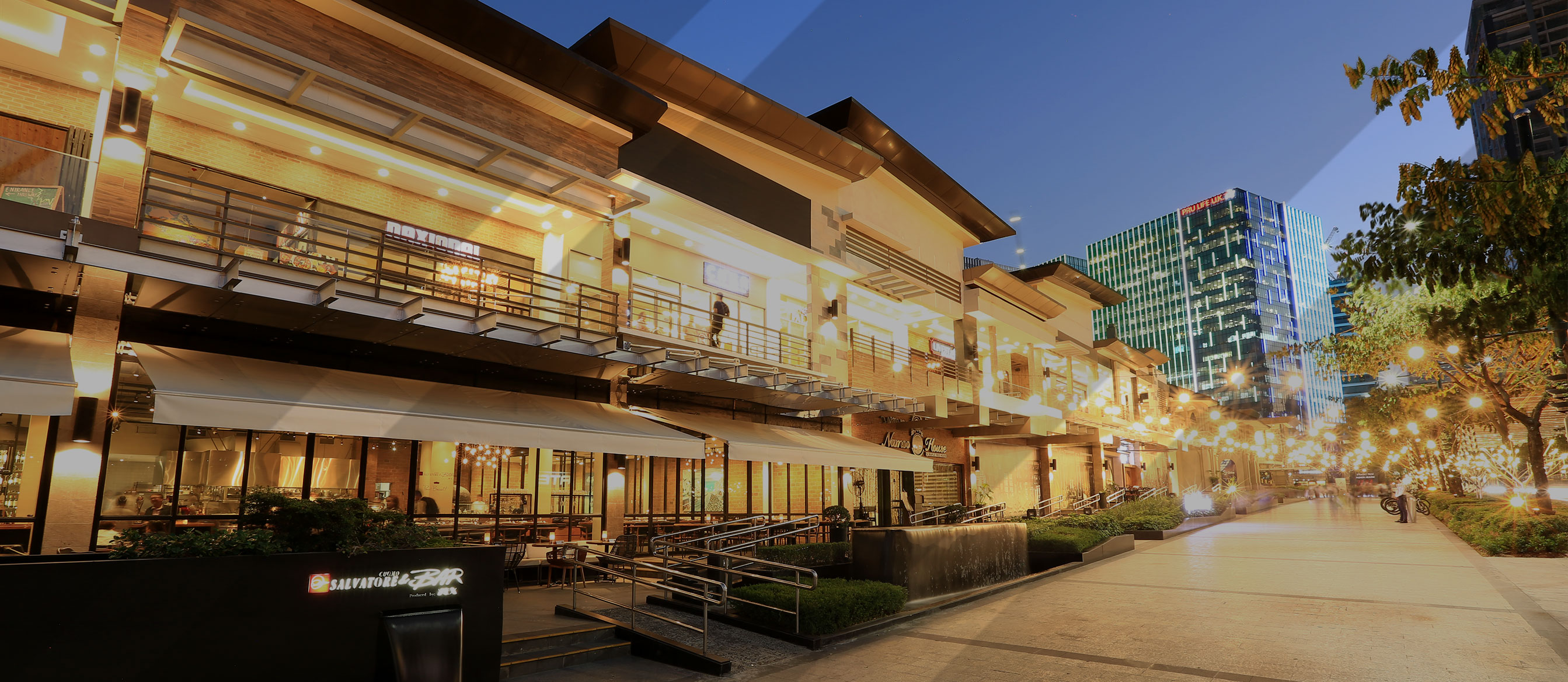
Eastwood City's leisure and entertainment zones are designed to complement the office and residential buildings in the community township. As of mid-2010, Megaworld leased the properties in the leisure and entertainment zone, comprising an aggregate of approximately 50,000 sq. m. of leasable floor area to close to 400 commercial tenants.
FORBES TOWN CENTER
The Forbes Town Center project is located on five hectares of land in Bonifacio Global City, Taguig, Metro Manila, and is adjacent to the Manila Golf Club, the Manila Polo Club and the prestigious Forbes Park residential subdivision. Upon completion, Forbes Town Center is expected to consist of residential, retail and entertainment properties.
Once completed, the Forbes Town Center residential zone is expected to consist of 13 towers. The leisure and entertainment zone, on the other hand, is expected to consist of 20,000 square meters devoted to bars, restaurants, and specialty shops, which are designed to complement the residential buildings in this development as well as the surrounding office areas in Bonifacio Global City.
MCKINLEY HILL
McKinley Hill is Megaworld's flagship project to-date. The project being developed on approximately 50 hectares of land located in Fort Bonifacio, Taguig, Metro Manila. Once completed, the McKinley Hill project is expected to consist of office, residential, retail, educational, entertainment and recreational properties.
The McKinley Hill residential zone consists of subdivision lots for low-density single-detached homes and clusters of low-rise residential garden villas. Construction of the development began in 2005.
The subdivision project includes amenities such as a clubhouse and communal swimming pool for residents. The residential zone is also comprised of several garden villa clusters with five or six storey villas in each cluster. In addition, the Stamford Executive Residences, the Morgan Executive Residences, each consisting of three residential clusters, and the Venice, a two-cluster development, are under construction.
The office properties in McKinley Hill are expected to consist of Grade A office buildings. Similar to Eastwood City CyberPark, tenants are expected to include major multinational corporations, largely comprised of software developers, data encoding and conversion centers, call centers, system integrations, IT and computer system support. Corporate zone tenants will also be entitled to various tax incentives in conjunction with the PEZA special economic zone status conferred upon the McKinley Hill CyberPark.
The McKinley Hill leisure and entertainment zone is expected to consist of bars, restaurants, specialty shops, cinemas and sports complex, which are expected to complement the office and residential buildings in the community township. The leisure and entertainment zone is expected to have a Venetian theme. The first phase of the leisure and entertainment zone was completed in 2009.
McKinley Hill is also the site of three international schools; namely, the Chinese International School, the Korean International School and Enderun College, a hotel management institution affiliated with Les Roches of Switzerland. Likewise, the British and Korean Embassies are located within the project.
NEWPORT CITY
Newport City is a 25-hectare mixed-use project in Pasay City, Metro Manila. It is located on land that was part of the Villamor Air Base, adjacent to the Villamor golf course and across from the NAIA-3. The project will integrate corporate, residential, leisure and entertainment components. Newport City adopts a similar integrated "live-work-play" approach as Eastwood City with the exception that Newport City is targeted towards tenants and buyers who consider proximity to NAIA-3 an advantage. There are four hotels that are part of the Resorts World Manila development on a portion of Newport City. Resorts World Manila also includes leisure, gaming and shopping developments. Newport City is also expected to include medium-rise residential buildings and other tourist-oriented retail developments.
The Newport City project has been granted tourism special economic zone status by the PEZA. In addition, PEZA approved the Newport City Cybertourism Zone as a special economic zone.
The Newport City residential zone, upon completion, is expected to consist of 20 eight- to nine-storey medium-rise buildings that are grouped in clusters of five to six buildings.
The Newport City corporate zone is expected to include Grade A office buildings. Tenants in the CyberPark are expected to include major multinational corporations, largely comprised of BPO businesses, cargo logistics services and airline-related businesses that consider close proximity to NAIA-3 an advantage. Similar to its other mixed-use projects, Megaworld expects to establish a PEZA special economic zone CyberPark at Newport City.
The Newport City leisure and entertainment zone is expected to consist of space which Megaworld intends to lease to tenants who will operate bars, restaurants, retail and tourist oriented shops, which are designed to complement the office and residential buildings in the community township. The Company's joint venture development, Resorts World Manila, which is a leisure and entertainment complex comprising gaming facilities, restaurants, hotels and shopping outlets, among others, opened in August 2009.
The Newport City hotel zone comprises the following four hotels. Construction of the luxury Maxims Hotel is expected to be formally open in the third quarter of 2010. The five-star hotel managed by Marriott comprises 342 rooms. Construction of the hotel commenced in 2006 and hotel opened in October 2009. The Remington Hotel targeted at budget travellers is expected to be completed in the second quarter of 2011 and the Hamilton Hotel is expected to be completed in 2012.
MANHATTAN GARDEN CITY
Manhattan Garden City is a residential development project which is expected to consist of 20 residential towers containing 9,000 condominium units on a 5.7-hectare property at the Araneta Center in Quezon City. The concept for the Manhattan Garden City project is based on integrating a residential community with a major Metro Manila transportation hub that directly links to two light rail transport lines, the MRT-3 and the LRT-2. The MRT-3 line runs north to south along the EDSA highway in Metro Manila while the LRT-2 line runs east to west across Metro Manila along Aurora Boulevard. All key areas along the transportation lines within Metro Manila will be accessible from the development. The amenities of the Araneta Center will also be available to residents of Manhattan Garden City, such as the recently completed Gateway Mall that includes a state-of-the-art cineplex with 10 movie theaters.
Megaworld is to develop all of the residential developments in Araneta Center, while it's joint venture partner, Araneta Center, Inc. will develop the commercial spaces.
CITYPLACE
The Cityplace project is a mixed-use project under development on a 2.5-hectare lot in Binondo, Metro Manila. The development is expected to have over 500 residential condominium units and a shopping center. The development is also expected to include new parks, a public car parking facility, new bypass roads and pedestrian overpasses to make the project environment and pedestrian-friendly. Cityplace is the largest redevelopment in the City of Manila in the last 30 years or so.
Additional Developments In Fort Bonifacio
NORTH BONIFACIO/NAPOLCOM
Megaworld is developing North CBD, an 8.38-hectare property for residential use in the northern district of Fort Bonifacio in Taguig, Metro Manila. Alongside the North Bonifacio development, Megaworld is also developing a 7.1-hectare property for mixed-use owned by NAPOLCOM. Megaworld will develop these properties under a joint venture arrangement with the BCDA.
JUSMAG
Megaworld is developing an approximately 34.5-hectare portion of the Joint United States Military Advisory Group ("JUSMAG") property owned by the BCDA located across from McKinley Hill in Taguig, Metro Manila. The development of the JUSMAG property is another joint venture undertaking with the BCDA. Megaworld expects that a minimum of approximately P22 billion will be spent on the development of the property over 20 years, which has a designated maximum allowable gross floor area of approximately 1.38 million sq. m.
Megaworld acquired the rights to develop the JUSMAG property through public bidding in the first quarter of 2010. Under the joint venture agreement for the property, BCDA provides Megaworld with the land to be developed for mixed-use projects.
OTHER PROPERTIES
On October 2, 2007, Megaworld acquired a 54.5-hectare parcel of land, site of the old Iloilo airport, in Mandurriao, Iloilo from the Government. Megaworld plans to develop the property into a central business district in Iloilo, with BPO offices. The planned development will comprise office buildings, educational facilities, residential projects, a hotel, a convention center as well as retail and recreational areas. A portion of the development will be registered as a special economic zone with the Government, which will allow it to benefit from a tax holiday period as well as other incentives for investors.
Megaworld also plans to develop a 25-hectare property in Mactan, Cebu. The property is expected to comprise offices, BPO facilities and leisure facilities.
|
Emperador Brandy
Emperador Brandy, EDI's flagship product, continues to do very well in the market and is still considered the drink that features the distinct taste of success.
Success is the distinct trademark of Emperador Brandy, the flagship product of Emperador Distillers, Inc. (EDI), the food and beverage arm of Alliance Global Group, Inc. (AGI). Since its launch, Emperador has been the brandy of choice for the more discriminating alcohol drinkers—those whose own lives have been marked by success. However, only a successful product can rightfully claim to cater to successful people, and Emperador Brandy is one such product.
The brandy has had a long string of achievements. For one thing, Emperador was hailed as the world's largest-selling brandy in terms of the number of bottles sold, according to research published in the June 2007 issue of Drinks International, a UK-based beverage magazine.
Emperador was also included in Reader's Digest's Trusted Brand Awards—an honor given to brands that have distinguished themselves in terms of quality, value, trustworthiness, strong image, and understanding of customer needs. Emperador was presented with this highly prestigious award four times—in 2004, 2006, 2007, and 2009. This is an achievement that no other local brand in the same category has ever attained.
Emperador's sister product is Generoso Brandy, a lighter and sweeter brandy that targets the younger market in general and the female market in particular. Generoso was introduced to the market in 2006 and has since been doing well in its respective niche. In fact, Emperador and Generoso together hold the largest share in the local brandy market.
In 2009, EDI has once again ended a relatively successful year. Despite the increased competition and the softening of the brandy market due to the harsh economic conditions, EDI's sales was slightly affected by 1.4% and EDI closed the year with higher gross profit and net income.
Several developments contributed to making 2009 another successful year for EDI. Emperador Light, an aptly labeled lighter variant of Emperador Brandy, was introduced to the market in December. This product effectively complements Generoso Brandy in targeting the younger market and is seen to get stronger as it becomes more popular in the years to come.
The Bar, a flavored alcoholic beverage, was launched in April 2009 with two variants: lemon-and-lime gin and orange-flavored vodka. A few months later, a new variant was introduced: apple vodka. The initial sales performance of The Bar was encouraging, particularly during the last quarter of the year, and the product is expected to perform even better during the coming holiday season. In fact, the product's performance was so encouraging that another variant was launched in April 2010: strawberry vodka.
The whole of 2009 and the first half of 2010 can be considered a highly challenging period, due to the economic downturn that the country continued to face. Nevertheless, EDI turned in a creditable performance during this time on the strength of its high-quality products and innovative marketing schemes.
As the whole nation rebounds economically in the later part of 2010 and the sale of premium consumer items like alcoholic beverages improves, EDI will continue to provide its consumers with high-quality beverages to suit the tastes of a diverse market. With this in mind, EDI is set to launch new products and new variants of existing products with the objective of ensuring that 2010 will be an even more successful year for the company.
Pik-Nik
Honey Mustard, Cheddar Cheese and HOT! Shoestring Potatoes are three new Pik-Nik variants sold here and abroad. Today, Pik-Nik comes in 10 different choices of all-natural, preservative-free potato snacks.
E & J Gallo Wines
To tap into a new market segment – the female wine connoisseurs - the Company launched the Carlo Rossi California Red Muscat in October 2005. Made from Muscat Alexander and Canelli grapes, the Red Muscat offers the sweet, subtle tastes of cherry raspberry and cranberry. It contains all the healthy attributes of premium red wines, and is a superb accompaniment to Filipino dishes.
In February 2006, the Carlo Rossi Red three-liter box was launched. Packed in a compact stay-fresh container with a handy dispensing nozzle, it carries the same well-rounded, black cherry flavor of the original California Red.
Glass Manufacturing
Alliance Global Group, Inc. belongs to an elite circle of the country's top four players in the glass container manufacturing industry today. Through its wholly owned subsidiary Anglo Watsons Glass Inc., it makes flint glass bottles and jars for leading local producers of wines, liquors, juices, soft drinks, food preserves and food flavorings.
Its 57,938-square-meter glass manufacturing plant at the Canlubang Industrial Estate serves an impressive roster of clients including makers of well-known food and beverage brands. The plant runs on a 24-hour shift from its strategic location in Canlubang Laguna, a major industrial hub south of Metro Manila.
In the first quarter of 2006, sales of glass containers rose by 46 percent despite a temporary halt in glass production due to ongoing repairs in plant facilities. Alliance Global relied on its stockpile of glass containers supplemented with imported items to meet customer requirements.
|
McDonald's
McDonald's leads the industry in terms of overall food quality, overall service, and value for money. GADC's thrust is to improve the quality of food that it serves and the overall experience in all McDonald's branches.
McDonald's has always been a frontrunner in the quick-service restaurant business worldwide. One thing that sets the brand apart from the rest of its global competitors is its consistent focus on quality, service, cleanliness and value.
Here in the Philippines, the McDonald's brand is carried by the Golden Arches Development Corporation (GADC), the quick-service restaurant arm of Alliance Global Group, Inc. (AGI). When AGI invested in McDonald's in 2005, it committed to GADC's philosophy to live up to the standards of quality that McDonald's founder Ray Kroc had set. As such, the local McDonald's franchise strengthened its excellence in all aspects of its operations, accelerated its branch re-imaging program and reinforced its focus on value for money promotions and is now one of the most trusted, admired and patronized fast-food chains in the country.
In 2009, McDonald's once again experienced another banner year as sales and franchise revenues grew by 13.9% from the previous year's level. Sales, in particular, went up by 13.4% and revenue from franchised restaurants went up by 22.9%. These achievements were due to the increase in business that resulted from growth in guest counts from its existing store base and the Company's branch expansion and reimaging program during the year.
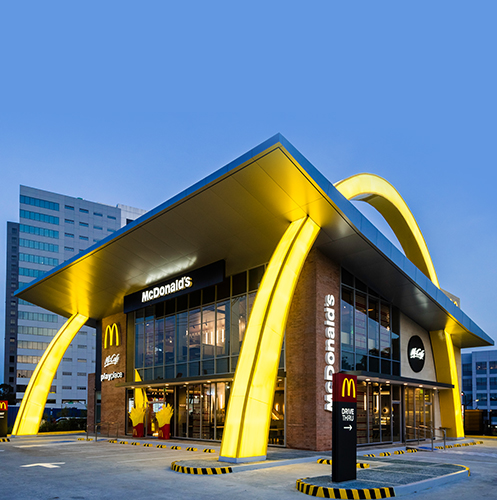
Some 17 branches were opened in 2009, bringing the total number of McDonald's restaurant to 296 at yearend. Moreover, as of July 2010, McDonald's has completed the rebuilding and re-imaging of seven branches.
As in past years, in 2009 and the first half of 2010, McDonald's remained focused on key growth pillars of value and service as well to gain a larger base of customers. Value offerings remained the priority like P25 Everyday McSavers (with sundae, float, fries and burger McDo) and 2-pc McSaver Meals for P50. To add variety and keep things fresh and exciting, other promotions were also introduced. For instance, Ice Age 3 Happy Meal promo and the Coke World Cup glass promo, in time for the FIFA World Cup global football phenomenon.
GADC also ensures the local franchise's strict adherence to the restaurant operations standards to ensure that McDonald's customers around the world are getting superior Quality, Service and Cleanliness (QSC) and to improve the level of store performance and accountability as it relates to people, service and food safety.
For the remainder of 2010 and beyond, McDonald's plans to continue with its focus on value for money and service and the expansion of its branch network even further. In fact, the Company's branch expansion program will soon shift to a higher gear as some 25 to 35 branches are planned to be opened every year, from 2010 to 2012.
Complementing this, the redesigning and reimaging of existing branches will continue, ensuring that the design and facilities of older branches are aligned with the new modern look of McDonald's renovated and reimaged stores.
Lastly, McDonald's will continue to offer great value, fast service as well as promotional schemes that leverage on the McDonald's brand's global assets. The past years have indeed been great for McDonald's. As the competition in the local quick-service restaurant business further intensifies in the years to come, McDonald's focus on maintaining its excellent quality in all aspects of operations will again serve them well. With this in mind, McDonald's will continue focusing on its core strength—that of providing high-quality value-for money products and best service. Indeed, for McDonald's, quality is priority.
|
Travellers International Hotel Group, Inc.
This is a continuation of the previous year's theme "A Little Closer to the Dream." This time the dream is fast turning into a reality, with the Company's projects near completion, Travellers is on the verge of living the dream.
It all started with a dream of venturing into the largely untapped tourism industry in the Philippines. The objective of AGI was not only to reap the financial rewards of such an endeavor but also to do its share in uplifting the country's economy by enhancing the local tourism industry and making the tourism industry an engine for economic growth.
AGI's noble aim stemmed from the realization that other Southeast Asian countries have overtaken the country in terms of tourist arrivals. Despite the fact that the country experienced a 1.5% increase in tourist arrivals in 2008 with 3.14 million tourists, which further increased to almost 4 million in 2009, the number of tourist arrivals to the country is still much lower than the number of tourists visiting other Southeast Asian countries like Malaysia, Thailand, and Singapore. In fact, over 70% of the almost 62 million annual tourists to the region visit these three countries.
It is a fact that the Philippines has many attractive tourist destinations, scattered across the country. Indeed, the Philippines has more than its fair share of beautiful and interesting places. Still, most tourists to the region seem to prefer going to the country's neighbors. In order to uplift Philippine tourism, more work has to be done. With this in mind, AGI dared to dream. It was definitely a big dream, one that no ordinary company can easily transform into reality. But AGI is not an ordinary company.
In June of 2008, AGI, through Travellers International Hotel Group, Inc. (Travellers International), received the first provisional license issued by the Philippine Amusement and Gaming Corporation (PAGCOR) to participate in the latter's leisure and entertainment master plan, at a time when the Company's dream of venturing into tourism-related development began to take shape.
Travellers International is the only company with a PAGCOR license to develop and operate two casino sites from 2005 to 2033. Travellers International is a joint venture with Genting Hong Kong Limited (formerly known as Star Cruises Limited), a member of the Malaysian Conglomerate Genting Berhad and the world's third largest cruise line operator.
Travellers' first project was Resorts World Manila, the country's very first integrated tourism estate that opened to the public in August 2009. Travellers International will spend over US$500 million to develop Resorts World Manila, which includes the all-suite Maxims Hotel, the five-star Marriott Hotel, the Luxury Hamilton Hotel, and the budget Remington Hotel. The resort also features a grand mall, a world-class theater that seats 1,500 people, restaurants, high-end luxury shops, an exclusive lifestyle club, spas, and gaming areas.
The casino, in particular, features about 300 table games and 1,000 gaming machines. Affordable packages that start as low as P500 include meals, gifts, raffle coupons, slot gaming credits, and entrance to Bar 360, a modern establishment that features all-night shows by performers from all over the globe. The bar currently showcases foreign acts from Belarus, Ukraine, and Russia. Alternating with these foreign artists are the musical concerts of local jazz, rock, pop, and bossa nova artists.
The mall, in turn, will house state-of-the-art cinemas, various shops that offer world-renowned fashion items and accessories, specialty boutiques, and an extensive range of local and international restaurants that encircle an air-conditioned indoor piazza with a glass skyline.
Among Resorts World Manila's fine-dining restaurants that serve intercontinental specialties are Passion, which serves mouth-watering Cantonese and Southeast Asian cuisine; Ginzadon, with its sumptuous offerings of Japanese and Korean dishes; Noodle Works, which offers the best Asian noodles; and Mercado, with its buffet of exquisite Filipino cuisine, to name a few. The center bar of Bar 360 also offers cocktails, wines, and other alcoholic drinks alongside a wide array of hot and cold beverages.
The Maxims Hotel is said to be the country's first deluxe hotel with 172 all-suite rooms, each furnished with modern facilities and served by a personal butler. The hotel has three Royal Villas, each having an area of 535 to 548 square meters. Each villa has its own patio, garden, pool, kitchen, massage room, and dining area. The hotel's 600-square-meter presidential suite features a Jacuzzi, an audio-visual room, two pavilions, and a garden, among other facilities.
The Marriott Hotel, in turn, is the first five-star international hotel to open in the complex. It has 342 rooms, three dining outlets (Velocity Entertainment Bar, Cru Steakhouse, and the Marriott Café), a ballroom, multiple meeting rooms, a spa, and other amenities.
Resorts World Manila began operation in August of last year. The resort is expected to be completed by 2012 and will generate more than 10,000 direct and indirect jobs.
Resorts World Manila also inaugurated the Newport City Transport Terminal, which provides round-the-clock access to and from the airport terminals as well as various parts of Metro Manila and neighboring provinces. This transport hub has terminals for air-conditioned buses and shuttle vans that follow a regular schedule, as well as taxi cabs that are available round-the-clock. The air-conditioned buses have routes that come from as far north as Baguio City and as far south as Quezon Province. The shuttle service, in turn, has satellite terminals in different key areas in Metro Manila.
The Newport City Transport Terminal also connects different cities and provinces to the airport, with shuttle vans transporting travelers between Newport City and the Ninoy Aquino International Airport (NAIA) terminals 1, 2, and 3. With partner bus liners and shuttle services that run 24 hours a day, this terminal allows international tourists and local travelers and fun-lovers convenient and regular access to the resort.
The construction of the transport terminal is critical to the project since Resorts World Manila is designed to cater to both international and domestic travelers and fun-seekers. The resort's strategic location allows it to capitalize on several target markets such as the high-income groups living in neighboring areas like Fort Bonifacio, Makati, San Juan, and other cities and towns south of Metro Manila. The complex's proximity to the new airport, likewise, allows the resort to attract provincial and international tourists.
Resorts World Manila is touted as "the place to play" with facilities that provide virtually all kinds of entertainment—24 hours a day, seven days a week. Since Resort World Manila's partial opening, the number of visitors to the facility has reached the 2 million mark. AGI expects foreign visitors to the resort to reach 800,000 in the next three years, roughly translating to possible tourist receipts of at least US$1 billion.
Travellers International is also at work on a much larger tourism-related project: Resorts World Bayshore City, which will occupy about a third of the planned 90-hectare Bagong Nayong Pilipino Entertainment City Manila, a master-planned tourism-related development initiated by PAGCOR.
The almost 40-hectare Resorts World Bayshore City is envisioned to be a themed integrated tourism estate with around 2,500 hotel rooms. The resort will also include an iconic structure that will symbolize the country's culture and heritage. Much like its predecessor, Resorts World Bayshore City will also have modern leisure, retail, gaming, and entertainment facilities that will more than live up to the high standards set by the Resorts World projects in Singapore and Malaysia.
Moreover, living up to its role as a catalyst for local economic development, the Resorts World Bayshore City project is expected to create over 100,000 direct and indirect jobs in the near future.
Now, more than ever, the Philippines needs to improve its image and provide new and exciting reasons for tourists to flock to the country. The results of the recent presidential elections and the consequent positive changes that they promise are indeed crucial steps toward the right direction. However, with recent developments in the local socio-political arena as well as the spate of natural calamities in the past, all of which only serve to bring down an already ailing tourism sector, the country still needs all the help it can get to enhance its image, uplift tourism, and boost the local economy. As such, AGI's foray into tourism-related development through Travellers International could not have come at a more opportune time.
The opening of Resorts World Manila and the development of the larger Resorts World Bayshore City project allow AGI to help turn the country into an attractive tourist destination with world-class facilities and top-notch entertainment. In fact, Travellers International has committed to invest at least US$1.1 billion in developing the two Resorts World projects over the next five years.
Considering all these developments, AGI is indeed living its dream. The dream doesn't stop at these two projects, however. AGI is continuously looking at the possibility of developing more tourism-related projects in the years to come, with the same noble objective of transforming the Philippines into an established tourist destination comparable to the hottest tourist spots in the world and helping the government reach its long-term target of 8 million tourists annually starting in 2016.
As the current developments come into fruition and more projects are proposed and initiated, the country can now hope for the coming of the golden age of Philippine tourism. And the dream gets even bigger.
|
|
| |
|
|